Vacuum Belt Filter for Gypsum: Cake Washing Guide
The feed, wash-liquid circuit and cake-handling requirements to check before selecting a horizontal vacuum belt filter for gypsum slurry.
Key Takeaways
- Define the washing objective separately from the cake-moisture target.
- Test representative gypsum slurry before choosing filtration area or wash stages.
- Include wash-liquid supply, filtrate handling and cloth cleaning in the process review.
A vacuum belt filter for gypsum should be selected around the slurry and the required product, rather than filtration area alone. Gypsum streams from different processes can have different particle sizes, liquid chemistry and handling requirements. A filter that removes liquid satisfactorily may still need a different washing arrangement to meet the plant’s product specification.
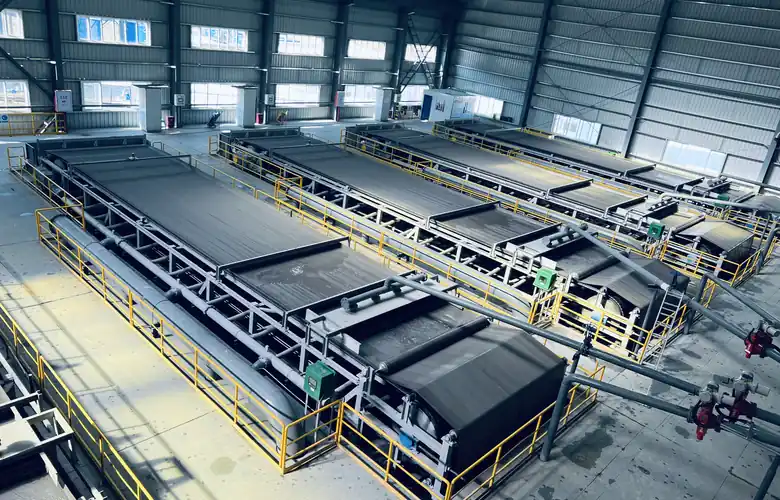
A horizontal vacuum belt filter brings feeding, cake formation, optional washing, vacuum dewatering and discharge into a continuous route. The engineering task is to establish which steps the actual gypsum slurry needs, and how they connect to the rest of the plant.
Start with the Gypsum Product Specification
Separate the requirements for the solid cake from those for the liquid. For the cake, document the next handling step and the required moisture or impurity specification. For the liquid, establish whether it will be recovered, recycled or sent for further treatment. This makes the washing objective clear before equipment is sized.
Washing removes or recovers material carried in the liquid retained by the cake. It should not be presented as a universal way to remove every impurity from gypsum. Identify the substance being measured, the sampling method and the required result. Where a limit is essential to the process, confirm it through representative tests.
Provide Representative Slurry Data
The supplier needs more than a daily production figure. Collect a sample that reflects normal operation, and identify any feed variation that the filtration line must accommodate.
- Slurry source, composition, particle-size distribution and feed-solids concentration.
- Dry-solids throughput, slurry flow and planned operating hours.
- Temperature, pH and information needed to assess material compatibility.
- Cake-moisture requirement, washing objective and downstream handling method.
Keep units and measurement methods consistent. A slurry-flow value and a dry-solids capacity describe different duties. Likewise, a target cake-moisture figure is useful only when the reporting basis is stated.
Review Cake Formation, Washing and Dewatering Together
On a horizontal belt, the slurry first forms a cake while liquid passes through the filter cloth. A washing section can then introduce wash liquid before further vacuum dewatering and discharge. Reliable evaluation therefore considers the whole sequence, rather than testing moisture reduction in isolation.
Check cake formation and release, wash distribution, filtrate separation and cloth regeneration. The required washing arrangement may be single-stage or multi-stage. Its suitability depends on the tested duty and the plant’s water and liquid-recovery requirements.
Counter-current washing can be considered where the liquid circuit benefits from limiting dilution. It is an engineering option to evaluate, not a standard configuration to assume for every gypsum project. The proposal should explain the wash-liquid route and where each filtrate stream will go.
Use Test Results to Compare Configurations
Compare candidate configurations against the same feed and acceptance criteria. Useful test observations include filtration rate, cake behavior, residual moisture, wash response and filtrate characteristics. Record wash-liquid use alongside the measured result so that an improvement in cake quality can be assessed against its water and downstream-treatment requirements.
Once those results are available, the supplier can review filtration area, belt speed, washing stages, vacuum duty, filter cloth and wetted materials. No single catalogue setting establishes all of these choices.
Include the Plant Interfaces in the Proposal
The equipment boundary matters. Confirm feed delivery, wash-liquid availability, filtrate collection, cake discharge, utilities and maintenance access. Allow room to inspect and service the cloth, belt and vacuum system without relying on an idealized equipment-only drawing.
For related fertilizer and phosphate streams, see our fertilizer slurry filtration and cake-washing solution. It outlines the process questions used to compare a continuous belt route with other filtration options.
Frequently Asked Questions
Can one vacuum belt filter configuration handle every gypsum slurry?
No. The feed, washing objective and cake-handling requirements need to be reviewed for the specific process. Representative testing is the basis for selecting the configuration.
Does a drier cake automatically mean better washing?
No. Residual moisture and removal of a specified soluble substance are different measurements. Define and test both when the process requires them.
What should be included in a gypsum filtration inquiry?
Send the slurry source, dry-solids capacity, feed concentration, available sample data, cake requirement, washing objective and project location. Add the wash-liquid supply and filtrate-handling plan where known.
For the wider selection process, read our vacuum belt filter selection guide.
Planning a Gypsum Filtration Line?
Share your slurry data and washing objective with Hexin to review suitable filtration options.