
Tailings Thickener Settling Test: What to Record Before Equipment Selection
Prepare a tailings thickener settling test with clear records for feed solids, flocculant dose, settling behavior, overflow clarity and underflow review.
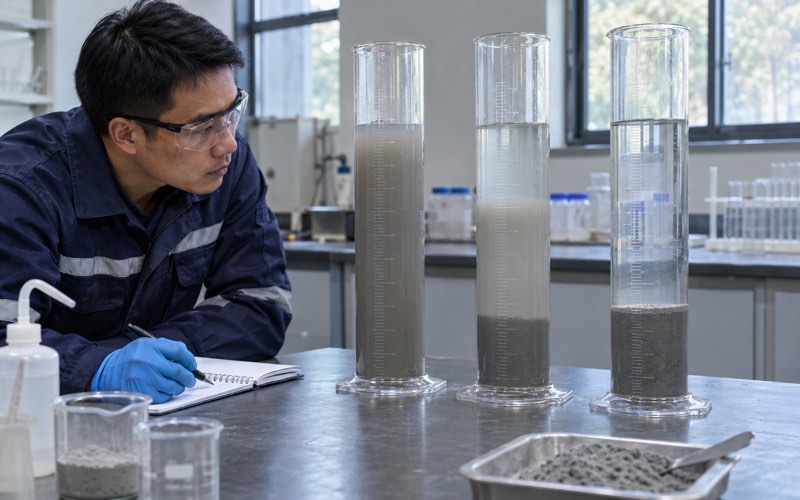
A tailings thickener settling test helps a project team compare how representative slurry samples settle, how clear the overflow becomes and how the settled solids behave. Useful records connect those observations to feed conditions, sample preparation and flocculant dose. They give the supplier a starting point for further testing and equipment selection.
Start with representative tailings
Record the sample source, sampling date and any changes in ore blend or upstream processing. Include feed solids concentration by weight, particle size distribution, slurry temperature and process-water source. Supply normal and peak dry-solids throughput alongside slurry flow. These describe different parts of the duty and should be reviewed together.
If feed conditions vary, ask the testing team which samples should represent normal operation and more difficult periods. Label and preserve the samples as agreed with the laboratory. A single convenient sample may leave feed variability unexplored.
Keep the preparation and dose basis consistent
For a flocculant screening test, record the polymer identity, preparation concentration, preparation time, addition sequence and mixing procedure. Report the dose on a clearly stated basis, such as grams of active polymer per tonne of dry solids. Confirm how that basis was calculated before comparing results from different laboratories.
Use the same agreed test method when comparing candidate conditions. Changing dilution, mixing and dose at the same time makes it harder to identify what caused a different result. Ask for repeat runs of the shortlisted conditions and retain the individual results.
Use a settling-test record sheet
| What to record | What it helps the team review |
|---|---|
| Sample identity, feed solids and water source | Whether the result represents the proposed operating feed. |
| Flocculant preparation, dose basis and mixing method | Whether trial conditions can be reproduced and fairly compared. |
| Interface height at recorded times | How the slurry settles through the observation period. |
| Supernatant clarity at an agreed time and sampling point | Whether the separated liquid may meet the intended reuse requirement. |
| Settled-solids concentration after an agreed period | How concentration develops under the particular test conditions. |
| Repeat runs, temperature and unusual observations | How consistent the results are and where further investigation is needed. |
Record the method used for clarity, whether it is a visual observation, turbidity reading or suspended-solids measurement. Keep that method consistent and report its units. Compare the result with the plant’s actual water-reuse requirement.
Review settling speed, water quality and underflow together
A condition with rapid initial settling still needs to be reviewed for overflow clarity and the intended underflow duty. Ask how the settled material behaves during withdrawal and what additional work is needed to assess pumping, compression and rheology. Concentration alone does not fully describe how a slurry will flow.
Discuss these observations with the supplier of the NGZ high-efficiency thickener. Laboratory cylinder results are one input to equipment selection. The engineering review also needs solids loading, feedwell conditions, bed behavior, operating hours and project-specific design allowances. Hexin’s tailings thickener sizing guide explains the broader sizing discussion.
Connect the test to the next process stage
If thickener underflow will feed a filter, provide the proposed underflow range to the filtration testing team. They need to review the feed expected at that stage. Check pumping, intermediate storage and the effect of feed changes on the downstream cycle.
See how thickening and filtration work together in tailings dewatering and the tailings dewatering application overview when reviewing the process route.
Prepare the equipment review package
Send the sample description, feed analysis, normal and peak throughput, test method, full observation sheet and required water and underflow outcomes. Include the proposed downstream process and available site layout. Share your tailings test information with Hexin to discuss suitable equipment and any additional test work.
Review Your Tailings Thickening Duty
Share your feed analysis, test records and operating requirements.