
How to Specify Vacuum Belt Filter Capacity for Variable Slurry Feed
Prepare a vacuum belt filter enquiry with matched feed cases, a dry-solids calculation and a practical operating-case table.
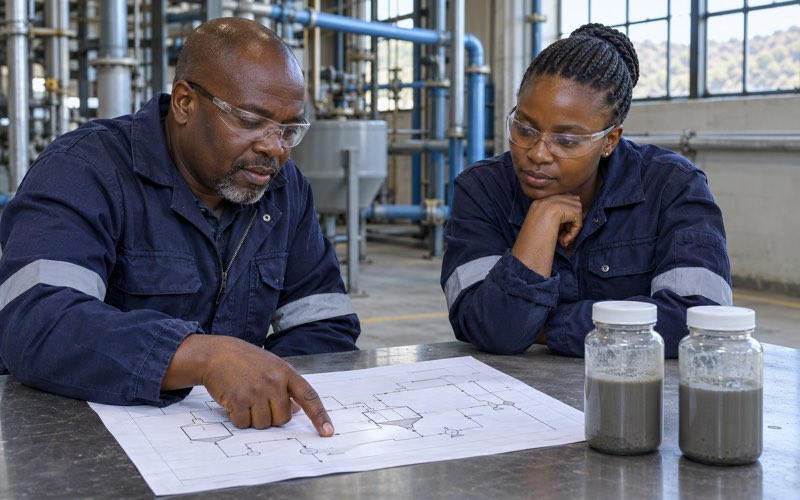
For a vacuum belt filter enquiry, describe the feed conditions that occur together. Record slurry flow, slurry density and solids concentration for each operating case, then add its duration, planned operating hours, cake moisture target and washing requirement. This gives the equipment supplier a defined duty to evaluate with representative filtration tests.
A single flow figure leaves part of the duty unexplained. A change in feed concentration changes the dry-solids load associated with that flow. The purchasing team needs a clear way to present those changes before comparing equipment proposals.
Put flow, density and solids concentration on one basis
Record slurry flow in cubic metres per hour and slurry density in tonnes per cubic metre. State whether the reported solids concentration is by mass or by volume. For a concentration expressed as a mass fraction, calculate the dry-solids feed rate as follows.
Dry-solids feed rate (t/h) = slurry flow (m³/h) × slurry density (t/m³) × solids mass fraction
A solids concentration of 15% by mass enters this calculation as 0.15. The density is the mass of the whole slurry per unit volume. If the source data uses a solids-volume fraction, obtain the corresponding mass basis before applying this calculation.
Keep the sample identity and measurement time with each set of figures. Density and concentration taken from different operating periods may describe different feeds. The resulting dry-solids load is one input to the review of a horizontal vacuum belt filter, alongside the material’s filtration response and required product conditions.
Compare two clearly defined feed cases
The following figures are hypothetical calculation examples, using independently assumed slurry density and concentration for each case. They illustrate how to prepare feed data for an enquiry. Actual equipment selection requires project measurements and filtration tests.
| Hypothetical case | Slurry flow | Slurry density | Solids by mass | Calculated dry-solids feed |
|---|---|---|---|---|
| A | 40 m³/h | 1.15 t/m³ | 15% | 6.90 t/h |
| B | 30 m³/h | 1.25 t/m³ | 25% | 9.375 t/h, approximately 9.38 t/h |
Case A gives 40 × 1.15 × 0.15 = 6.90 t/h. Case B gives 30 × 1.25 × 0.25 = 9.375 t/h. The lower volumetric flow in Case B accompanies the higher calculated dry-solids feed.
Ask the supplier to review each applicable combination of liquid and solids loading. The calculation describes the incoming feed. Filtration tests establish how that material forms a cake, drains, washes where required and releases under the selected conditions. Hexin’s vacuum belt filter selection guide covers the wider equipment and plant review.
Describe when each operating case happens
Provide a normal case and any known changes that matter to the filtration line. These could include a change in upstream thickener operation, a different feed blend or a period with higher slurry flow. State how often each case occurs, how long it lasts and whether the measurements were taken at the same time.
Distinguish a measured operating combination from a proposed future design case. If the highest recorded flow and highest recorded concentration came from separate periods, explain that relationship. Ask the engineering team which combinations the equipment must accommodate and what evidence is needed to assess them.
Also state planned production hours, feed interruptions, cleaning time and any intermediate storage. If daily tonnage is supplied, specify the hours available for processing it so the supplier can assess the hourly duty and operating assumptions.
Include cake and washing requirements in every case
For each feed case, state the required cake condition at the discharge point and how it will be measured. If cake moisture is reported on a wet basis, define it as water mass divided by wet cake mass. Record the intended handling route, such as conveying or further processing, so the receiving equipment can be considered in the review.
Where cake washing is required, give the washing objective and the way the result will be assessed, together with available wash-liquid information. Feed throughput, cake condition and washing results should be evaluated as a connected duty. For gypsum applications, the existing gypsum filtration and cake-washing guide develops the washing discussion.
Use an operating-case table in the enquiry
Complete one column for each applicable case. Add further columns when the feed has more than two relevant conditions. Use the same units and reporting basis throughout.
| Enquiry field | Normal operation | Known variation or proposed design case |
|---|---|---|
| Material, sample ID and particle-size data | Enter data | Enter data |
| Slurry flow, m³/h | Enter measured or specified value | Enter value and its basis |
| Slurry density, t/m³ | Enter corresponding density | Enter corresponding density |
| Feed solids by mass, % | Enter corresponding concentration | Enter corresponding concentration |
| Calculated dry-solids feed, t/h | Calculate from the same case | Calculate from the same case |
| Frequency, duration and operating hours | Describe operation | Describe operation |
| Cake moisture target and measurement basis | State requirement | State requirement |
| Washing objective and available wash liquid | State requirement, if applicable | State requirement, if applicable |
| Trial reference and downstream handling | Identify evidence and interface | Identify evidence and interface |
Ask what the equipment proposal covers
Request the feed cases and operating assumptions used to select filtration area and configuration. Review the test sample, cake thickness, belt settings, vacuum conditions and any washing stages behind the proposal. Filter cloth belongs in that test configuration because the material, cloth and operating conditions are evaluated together.
Agree which further tests are needed where a proposed case has limited evidence. Share your completed operating-case table with Hexin to discuss the filtration duty and equipment configuration for your project.
Review Your Vacuum Belt Filter Capacity Requirements
Share your slurry feed range, operating hours, cake moisture target and washing requirements to discuss a suitable equipment configuration.